
George Brigman on ‘Jungle Rot’: An Interview
George Brigman recorded ‘Jungle Rot’ when he was still very young. He was massively influenced by Tony McPhee of the Groundhogs, Captain Beefheart, Harvey Mandel, and Johnny Winter.
‘Jungle Rot’ is a bizarre, raw, brutal, acid-fueled fuzz guitar ripper that was originally released in 1975 and is considered by many to be an underground classic of heavy rock.
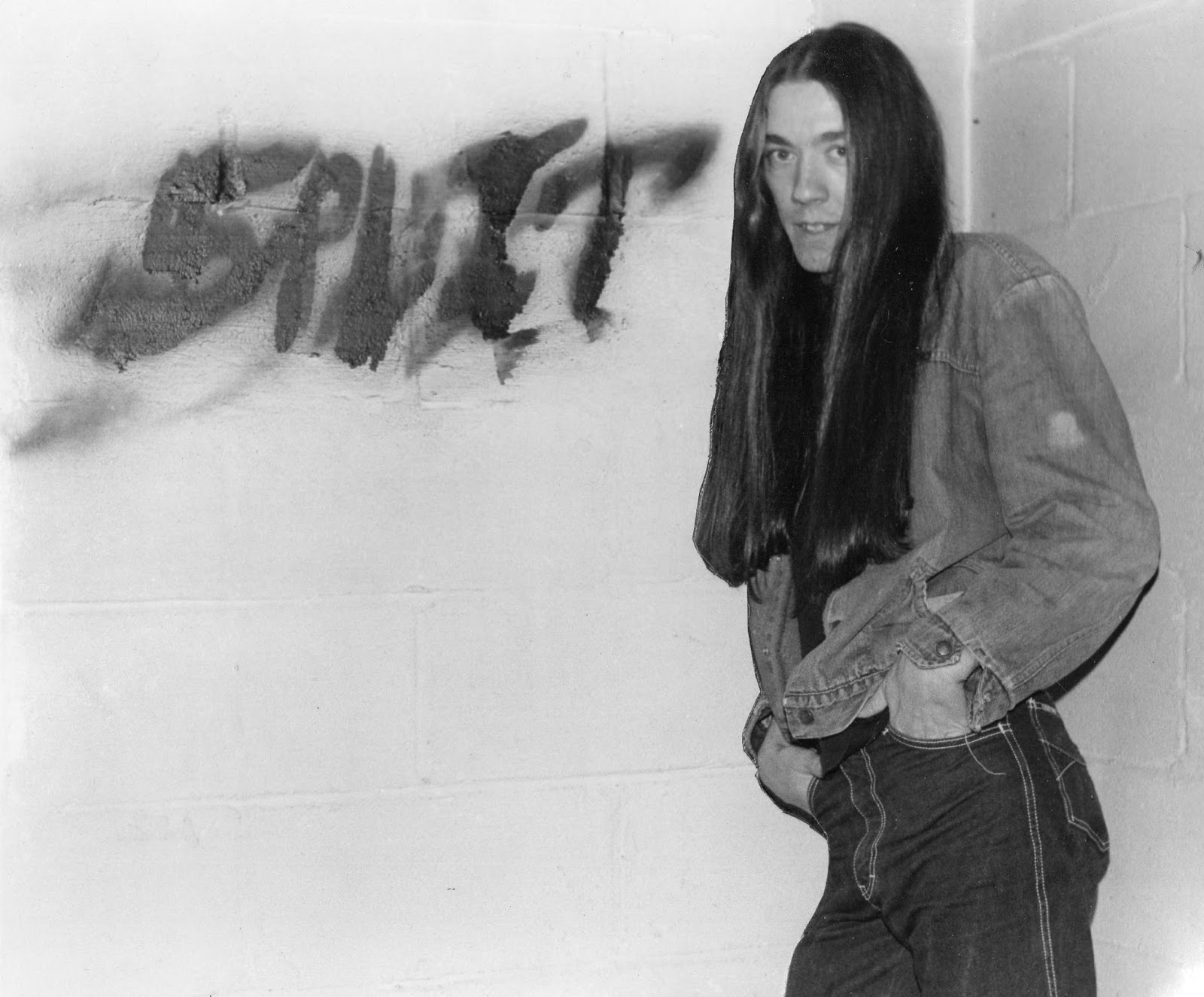
“I did ‘Jungle Rot’ pretty much at home”
Where and when did you grow up?
George Brigman: Born in 1954 in Baltimore, Maryland.
Was music a big part of your family life?
Yes and no. My parents encouraged my siblings and me to play an instrument. While my brother and sister tried a few instruments, I took to it and started playing trumpet when I was 8 years old. Once I wanted to switch to guitar and heavier music, that didn’t go over too well.
Did the local music scene influence you or inspire you to play music?
Not at all. It was “cover city,” and anyone trying anything original (outside their norm) was pretty much unheard of.
When did you begin playing music? What was your first instrument?
I started with trumpet at 8 years old in third grade. I did quite well with it and also played cornet, French horn, baritone, and tuba by the time I was 12 years old. By the time I was in junior high school (grades 7–8), I would play the other instruments at our band concerts. On a given song, I might play a French horn solo, then go back to trumpet for the next song. I’d play parts on alternate instruments that the other members couldn’t play. At the time it bothered me because I wanted to play my trumpet. Many years later I came to realize it was quite a compliment. Again, I didn’t see it that way when I was 12. By the end of junior high school, I wanted to move to guitar and rock. At this point my parents weren’t too happy about that, especially when I said I’d like to make it a career. Their whole attitude changed regarding me and music.
Who were your major influences?
Major influences as a kid: the Stones, the Animals, the Yardbirds, the Kinks, Otis Redding, James Brown. More of a Memphis guy than a Motown guy. The British Invasion had a big influence back in the day. From 1968 forward: Captain Beefheart, Groundhogs, Budgie, Gentle Giant, Soft Machine, Harvey Mandel, Howlin’ Wolf, John Lee Hooker, Mick Taylor, Blue Öyster Cult.
What bands were you a member of prior to the formation of George Brigman and Split?
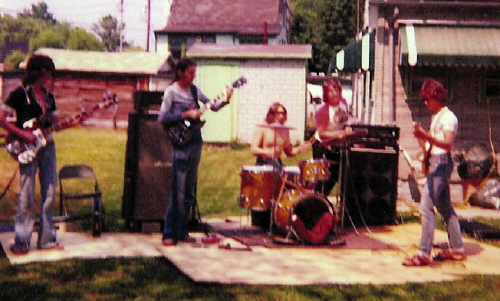
I started my own band, the George Brigman Band, then changed to Hogwash, then to Split.
How old were you when your first band formed?
I was 22 at the time, in 1976.
What was your role in these bands?
I was the leader, wrote the songs, and did most of the arranging, recording, etc.
When was the first gig you ever played?
We played the Kimberly Lounge (as the George Brigman Band) in East Baltimore in late 1976.
Do you recall the first song you performed before an audience?
Pretty sure it was an instrumental version of the song ‘Drivin’ On.’
What was the first song you ever composed?
I couldn’t really say. I was writing little ditties in elementary school—too many to remember!
When and where did George Brigman and Split play their first gig? Do you remember the first song the band played? How was the band accepted by the audience?
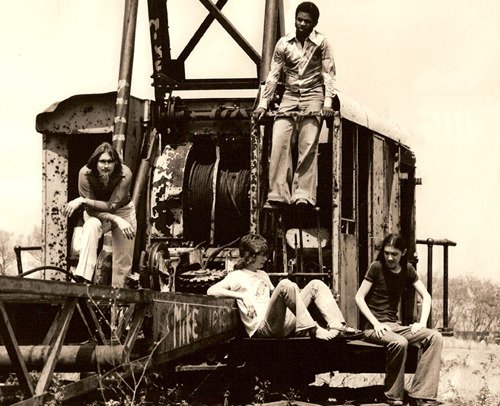
The Kimberly Lounge in East Baltimore, late 1976/early 1977. The first song back then would have been an instrumental version of ‘Drivin’ On’ or ‘Lucious Tentacles.’ We did a one-hour set and went over quite well. The club was packed—great crowd. Ron Sims was on vocals (there are two demo tracks with Ron on the Bonafide Records ‘Jungle Rot’ reissue). Ron was amazing, to say the least. Whenever Ron did ‘Schoolgirl’ or ‘Shy Man,’ the girls just melted.
What sort of venues did George Brigman and Split play early on? Where were they located?
Usual bars/clubs around Baltimore. It was best when we’d rent a hall and do a “true” concert—opening act and all that—in a concert setting, not a bar. These went especially well, and we made the most money doing that.
What was the writing and arranging process like? Did all the members have input?
In all versions of my bands, I did virtually all the writing and the bulk of the arranging. Chuck Westerman would come up with a few things from time to time, and I’d expand on them. He didn’t write lyrics and would come up with some cool bits. He never brought a complete song, though. For example, the song “Sweet Sweet Bulbs”: Chuck did a funky part, somewhat reminiscent of Rush’s ‘Think I’m Going Bald.’ He had the first part, so later I was playing with it and turned the funky part into a quick uptempo rocker, added the chorus and bridge, wrote the lyrics, and showed it to the band.
The song ‘The Truth’ was similar in process. Chuck had this real funky part, which actually became the verse. I added the intro, chorus, and bridge, then put it back together, and the boys liked it. Much different from where both songs started. I always encouraged the boys to write, but few did. Mitchell Myers, my bassist from the ’70s/early ’80s, wrote the most out of the people I played with. The band members had a say in their parts. I’d shape as needed and write specific parts as needed.
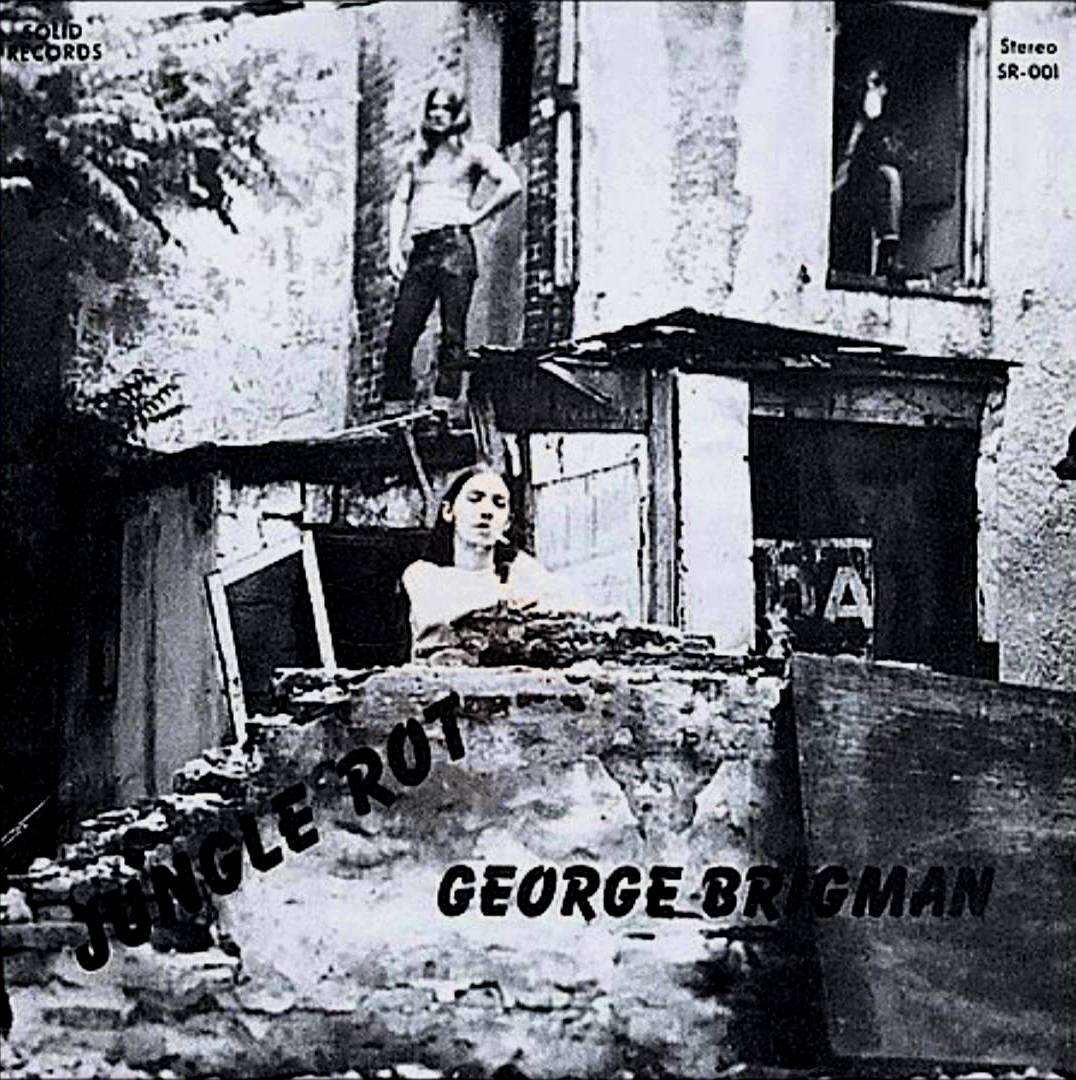
What’s the story behind your ‘Jungle Rot’ album? Where did you record it? What kind of equipment did you use, and who was the producer? How many hours did you spend in the studio?
‘Jungle Rot’ was never intended to be an album. I just wanted to record my songs—that’s what got me started playing guitar. I had been writing songs (got six published by a New York publisher starting in 1970, when I was sixteen) and was using demo houses, which cost some bucks, and of course I never had enough money to do them justice. I couldn’t stand the cheesy demos I’d get back of my stuff. I was determined that I’d have to play them myself to get them sounding as I heard them.
I had been playing guitar for about a year when starting ‘Jungle Rot’; the title track was the first recorded. Once I got started, I got a four-track recorder (which was huge back in the day). I started recording a track at a time, borrowed some basses, and did the bass tracks. I went to a small local studio, RMT, to mix the songs (the guy who ran the studio I knew from school, though we didn’t know each other at that time). Charlie Hand was the engineer, and he brought in a drummer, Jeff Barrett, who was recording and playing with Zen Archer at the time. We hit it off and started working together.
So the drums and a few vocals were recorded at RMT; everything else was done at my apartment. Once I had enough songs for an album, everyone I knew encouraged me to put it out, so I did.
Equipment used:
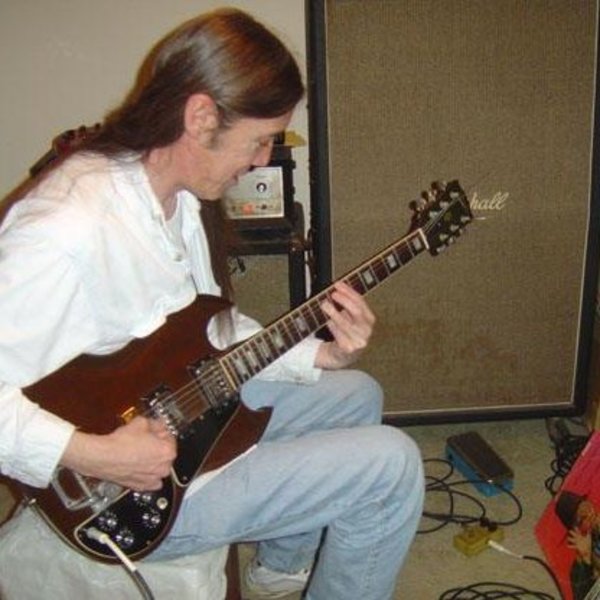
1969 Gibson SG, ’70s SG copy, Fender and Vox basses, Gibson GSS100 amp (4×10), Acoustic amp (4×12), Ampeg amp, MXR Phase 90, MXR Octave Splitter, Colorsound Wah-Swell, Univox Super Fuzz, MXR Distortion+, Mu-Tron Phaser.
I produced it; Charlie surely helped. It went well in the studio. The track “It’s Misery” gave Jeff fits. That one I wrote his part. “I’m Married Too” also gave him some trouble, but I’m guessing the Thai sticks may have had something to do with it!
Was there a certain concept behind it?
Just where I was at the time, pretty much. Young, angry, and full of piss and vinegar. More than a bit of anti-establishment beliefs (still have them, actually). I stuck out like a sore thumb in Baltimore, so it’s a bit in-your-face at times—like the city is coming down, but I’ll still be standing.
Please share your recollections of the sessions. What were the influences and inspirations for the songs recorded? How were the songs that made it onto the LP selected?
Again, I did ‘Jungle Rot’ pretty much at home for guitars, bass, and vocals. Ronnie Collier played harp on two tracks, sang ‘I’m Married Too,’ and played conga on ‘(T.S.).’ Jeff Barrett added the drums later at RMT Studios. There were two songs that I didn’t finish; actually, they just needed drums added to finish them. One, ‘All Night Long,’ had Ronnie again on harp, and I really liked this track. Another track, the blues piece ‘Hey Lady,’ had Nicky Longo on bass. He had an LP out and was popular in Japan. Nicky Longo was an East Baltimore boy.
Would you share your insight on the album’s tracks?
‘Jungle Rot’ – The title track was about Ronnie Collier’s wife, Janice. She was a hottie and a sweet girl, and Ronnie would always tease me about having to kill the both of us if we stepped out. So hence ‘Jungle Rot.’ All you had to do was watch Janice slinking away with her sassy walk—that’s the rhythm right there. Great girl.
‘DMT’ – Kind of speaks for itself. The area where I lived was known as the PCP capital of the world in the early ’70s, and it wore that badge with pride. PCP/DMT, looney tunes, six of one, half a dozen of the other. A day in the life in East Baltimore circa 1974.
‘Schoolgirl’ – Saw this Catholic girl at a bus stop in her uniform. Gorgeous.
‘I Feel Alright’ – Wrote that one in 11th grade, when my future wife told me we were “exclusive.” That was early (spring) 1971. She’s still with me.
‘(T.S.)’ – Tribute to Tony McPhee, big influence. The bridge I kinda nicked from him. Sorry, Tony.
‘It’s Misery’ – About working in a can manufacturing factory. Made cans for beer. Good money. Couldn’t imagine doing that for forty years. Used the octave splitter on that one.
‘I’m Married Too’ – Got a real kick out of this one. Ronnie hanging on, doing the vocals and harp. Funky track. Funny enough, it was the track Jeff had trouble with. Too much Thai, maybe?
‘Don’t Bother Me’ – Good R&B feel to me. A bit of slide guitar.
‘I’ve Got to Know’ – Same as above, actually.
What influenced the band’s sound?
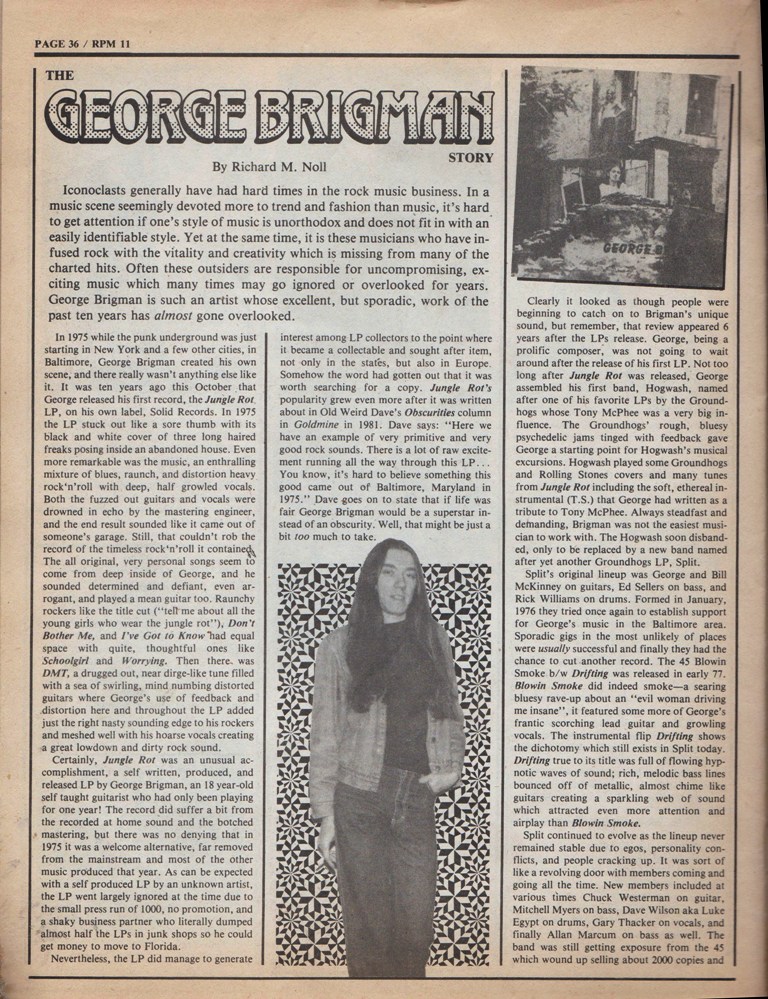
‘Jungle Rot’ wasn’t done by a band per se. It was pretty much myself and Jeff Barrett on drums. Groundhogs (Tony McPhee), Stones, Johnny Winter, Harvey Mandel, Captain Beefheart, Soft Machine.
Were you inspired by psychoactive substances like LSD at the time of writing the album? What’s your opinion about it?
Not a prude by any stretch of the imagination. Dabbled enthusiastically. If it works for you, have at it.
How pleased was the band with the sound of the album? What, if anything, would you like to have been different from the finished product?
Some of the vocal tracks could have been recorded better. Less effects, especially on the vocals. Mastering was all wrong—too much echo/reverb and boosting going on that wasn’t needed. The Anopheles reissue, mastered by John Golden, is much better than the original. The Obscure Oxide release also used the John Golden master. Stuff can always be better. It’s always a snapshot of time. Better pressings, for sure.
How many copies were made?
The original pressing was 1,000 copies.
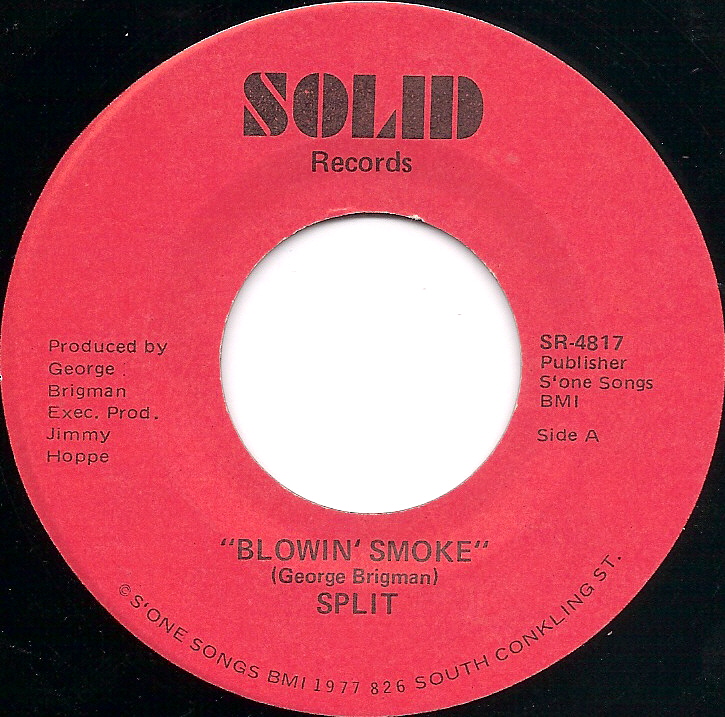
What about the single ‘Blowin’ Smoke’ / ‘Drifting’? Did the single garner any radio airplay? It was privately released on your own label, so it must have been a bit difficult to get major airplay.
When released, the single got airplay in sixteen states. While ‘Blowin’ Smoke’ was the A-side, it was ‘Drifting’ that got the majority of the airplay. That’s changed over time with the web, and ‘Blowin’ Smoke’ now gets played more than ‘Drifting.’ That may change since ‘Drifting’ is on a CD/vinyl compilation called ‘Best Of Down And Wired 4 – A Dose of Psychedelic Funk and Blue-Eyed Soul’ that’s just been released (June 2017). On the original release, I hired an outside promo firm to help with promotion, and we also gave it a push with our limited resources. A bunch of stations told us they liked the release—the label’s color was correct (red, like Columbia), but the label name was all wrong (Solid). It is what it is. ‘Blowin’ Smoke’ won a few nights in a row on a battle-of-the-bands show in upstate Pennsylvania.
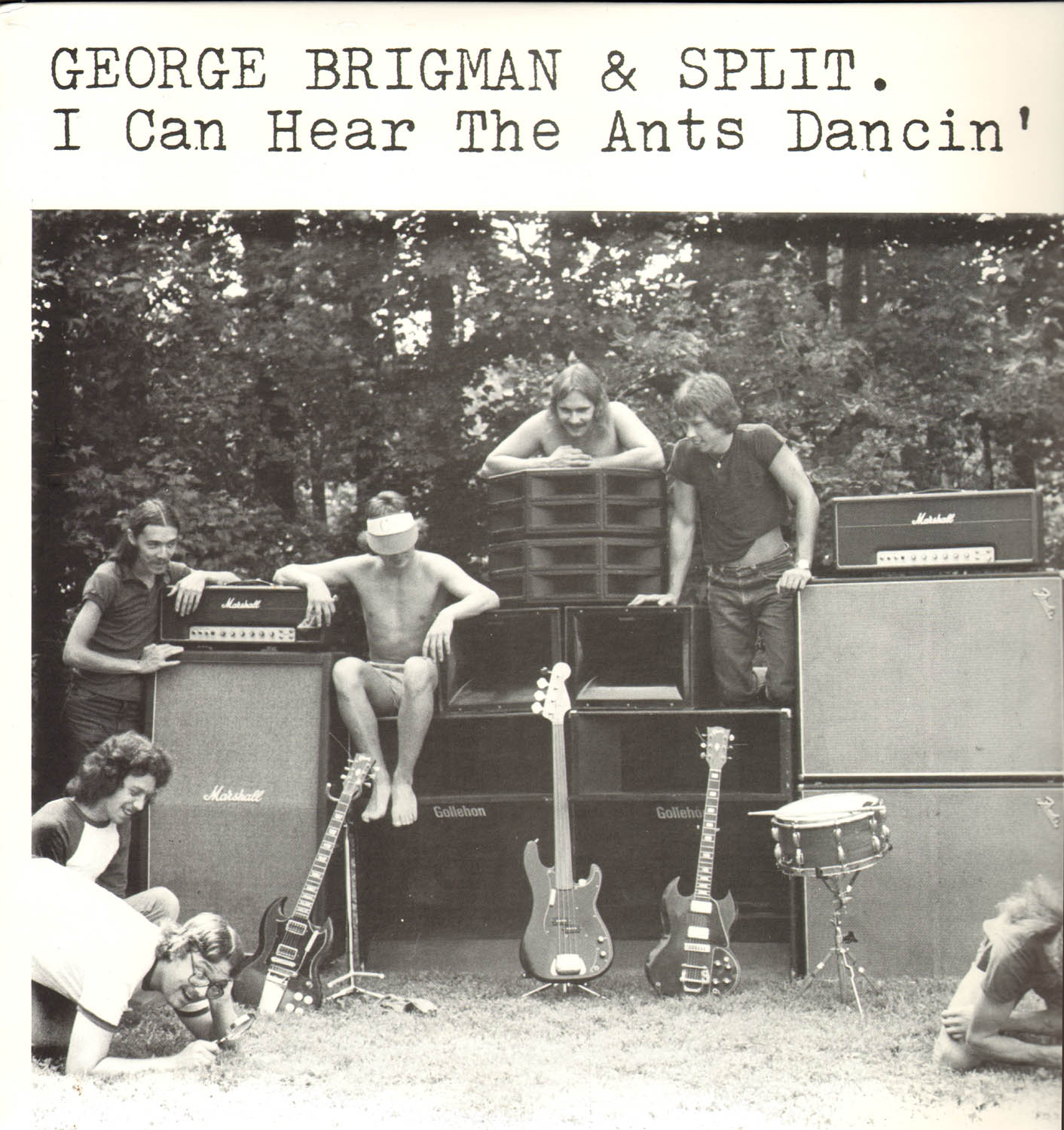
It was a few years until your next album, ‘I Can Hear the Ants Dancin’. What is the main difference between the first and the second album?
‘I Can Hear the Ants Dancin” was a band recording. While I wrote the material and did the bulk of the arranging, the other members all had input. I had also improved significantly on guitar as well as in writing, so I pushed the music further instrumentally than ‘Jungle Rot.’ ‘I Can Hear the Ants Dancin” is also live in the studio. Only the vocals and the title track had two guitar overdubs, and that’s it. This is what we sounded like live—more able to stretch the envelope and take some chances.
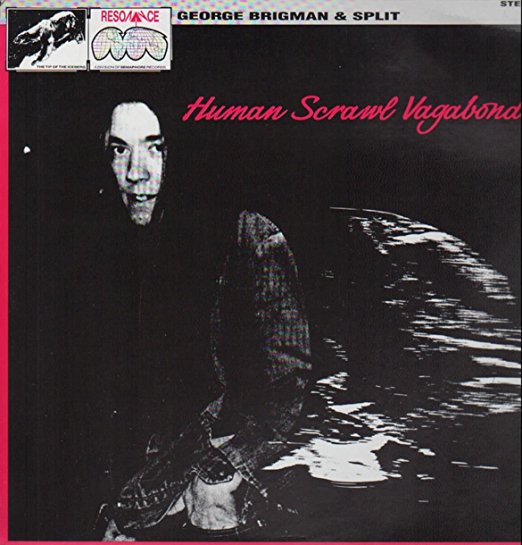
‘Human Scrawl Vagabond’ was your third release.
Some tracks were from ‘I Can Hear the Ants Dancin’,’ some with Mitchell Myers and Luke Egypt (Dave Wilson), and Wayne Hastings on a few vocals. The tracks ‘Lazy Eyes,’ ‘Symphony in Effigy,’ ‘The Truth,’ and ‘Sweet Sweet Bulbs’ were from the Ants sessions. ‘Mistress of Desire,’ ‘Grunts,’ and ‘Pull Your Pants Down’ are with Mitchell and Luke (Wayne Hastings on vocals). Again, this is live in the studio, with the vocals being overdubbed. It did well in Europe. Never got paid for this one— even had to buy my own copies.
What occupied your life between the late 1980s? Your latest album was released in 2007.
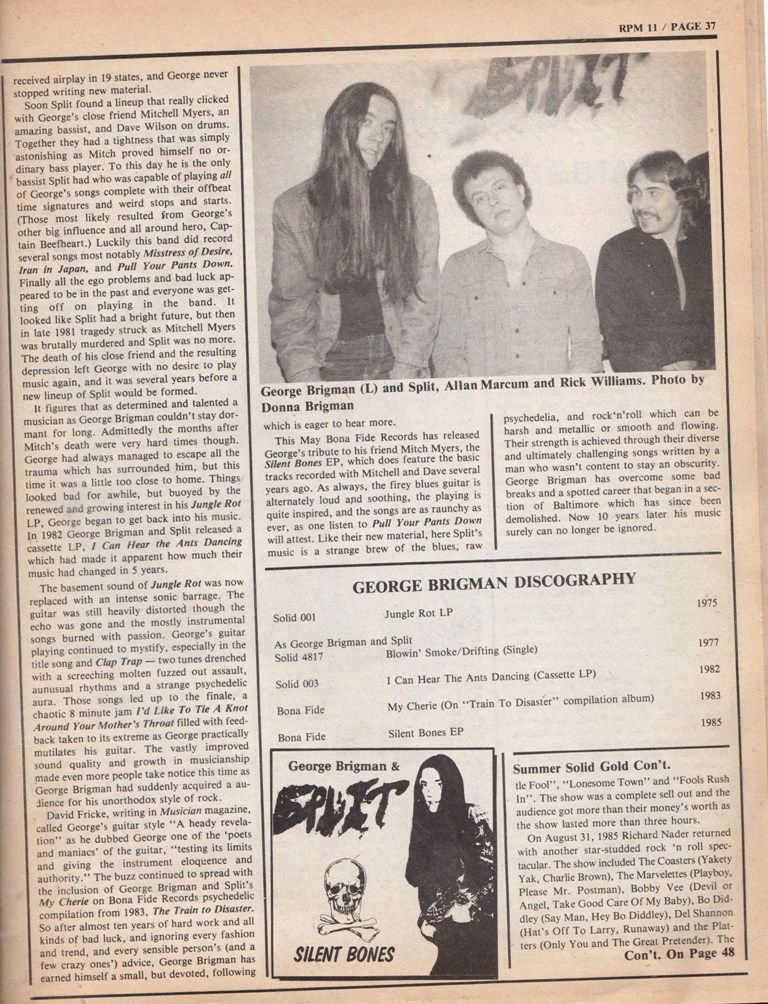
Life. After Mitchell Myers was shot and killed in the early ’80s, I was pretty fed up and took a break. I never stopped writing and playing but wasn’t interested in the band scene. I had a child in 1986 who had serious medical issues, and that obviously became my main focus. I also had more versions of Split, with more recordings in its various iterations. There is a YouTube clip of us performing ‘Make It One Day,’ which was broadcast on a cable station in Baltimore. That lineup had Al Marcum on bass/vocals and Rick Williams on drums. Rick has been in pretty much all of the group’s iterations outside of the time with Dave Wilson (Luke Egypt). Dave replaced Rick once I started with Mitchell Myers.
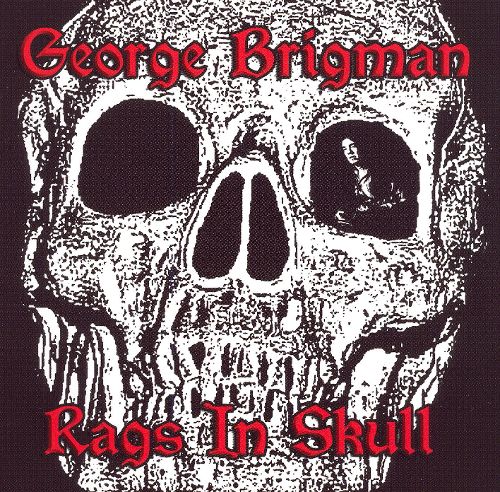
Around 2000, I got the recording bug again and promptly recorded about five albums’ worth of material, which resulted in ‘Rags in Skull.’ John Spokus played bass on ‘Rags.’ I still have four-plus albums from those sessions (not including the current stuff I’m working on). John Spokus also played bass on most of those tracks as well. He’s been a big help in getting this stuff done. After the ‘Rags’ sessions, I went back to I.T. (software design) and then had some serious health issues myself (‘Rags’ was almost done when I started dealing with the health issues).
What happened after the band stopped?
I got into software design and became a software engineer, which paid the bills. I also took a shot at playing ice hockey. I love that game and played four seasons in three years and loved every minute of it—including the broken nose, fractured jaw, broken toes, ligament damage, cracked hip, etc. Actually, I could have done without all those injuries, but I love playing hockey. I’ve continued to play, write, and record music, just not with a band. I also became seriously involved with Greyhound Rescue; we get the dogs off the tracks, re-home them, and place them in homes as pets. Greyhounds are the best!!! Please check our website: http://www.greyrescue.com/
Looking back, what was the highlight of your time in the band? Which songs are you most proud of? Why? Where and when was your most memorable gig? What makes it memorable?
I just love music—especially the creative process. I’ve been obsessed with it since I was a young boy. For the most part, I played with a good bunch of guys, and when a band is in sync, that is a special thing. The best part is when it all comes together—the music, words, arrangements—and everybody is hitting. It can become magic. All the bullshit you go through makes it all worth it when it happens.
Songs—geez, that kind of changes from time to time. I like ‘Some of My Best Friends Are Snakes,’ ‘Goin’ to Pieces,’ ‘Leprechauns,’ and ‘No More Humans’ from ‘Rags in Skull.’ Some of my favorites I haven’t recorded or released yet. Some were done live only (‘Second Son,’ ‘Angel of My Dreams,’ ‘Underwear for the Deaf,’ ‘Hammer n’ Tongs’). From ‘Jungle Rot’: the title track, ‘DMT,’ ‘It’s Misery,’ ‘I Feel Alright’ (always makes me think of my wife). From ‘Ants’: the title track, ‘Animal Dope,’ ‘Drifting,’ ‘Clap Trap.’ Anything with Mitchell Myers.
The best gigs were when we rented halls and put on a true concert, not trying to fit into the Baltimore club scene. We didn’t fit—they really wouldn’t let us. We did an outdoor show on July 4, 1977, where we played the Ants album plus a bunch of other stuff. What was so cool was that we played outside (not my favorite thing to do) down on the Island (Miller’s Island), which is a peninsula surrounded by water, clubs, and restaurants all having their own shows. Within minutes, people and cars were coming from everywhere, and by the second number the cops showed up. Instead of getting ugly, as it usually does when cops and I are involved, the residents backed the cops off, saying all the other clubs were having bands and live music and how organized we were. Some of the cops stayed and directed traffic. The residents let people stay on their property. Huge crowd—people, cars everywhere. Great show. Great day.
What are some of your favorite memories from the past?
Just the process, hanging with the boys. Making magic from time to time makes it all worth it.
What were some of your favorite bands?
Captain Beefheart, Groundhogs, Johnny Winter, Soft Machine, Gentle Giant, Budgie, Harvey Mandel, Kinks, Jeff Beck, Howlin’ Wolf, Yardbirds, Charlie Parker, Nirvana, Mick Taylor, Canned Heat, Animals, James Brown, Otis Redding, Brian Jones–era Rolling Stones.
Thank you for taking your time. Last word is yours.
Thanks so much for your interest and support.
Klemen Breznikar
George Brigman Website